
Jubilee Hall
Key notion"When the party stopped" "After the Independence" Public mourning of national hero International peace conference, 1952 Cultural center of the 70s in Yangon
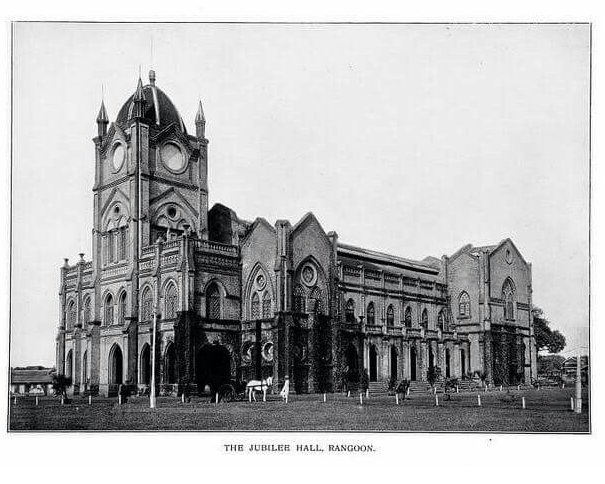
The two-story Jubilee Hall Gothic-style building was built in 1897 to celebrate the 60th-year reign of Queen Victoria ( her Diamond Jubilee). In its early days, it hosted events such as a meeting of British government officials to mark the opening of Yangon Zoo, as well as arts-and-crafts shows, talks, ordination ceremonies, wedding receptions for prominent figures of the town, and charity shows to raise funds to help Britain fight World War I. It was a gathering place for the powerful, educated, and wealthy elite. (Yan Aung, 2020) Just before the Independence in 1947, the fascist People’s Freedom League, led by Myanmar Independence hero General Aung San, drafted the country’s first constitution at the hall and read the 14 points of the Pinon Agreement. The same year, when General Aung San was assassinated in the secretariat (today Ministers’ Office), it became his funeral parlour, along with his cabinet ministers, lying in the hall for six months. After the Independence, Myanmar’s first national library and national museum were opened inside the Jubilee Hall. In 1952, the International Peace Congress was held in the hall. The site eventually became the centre of art and music. However, the National Library was moved to the city hall in 1968, and the museum was moved to Pansodan Street. Later, the hall continued to serve as a cultural place, hosting frequent cultural performances by the Culture Ministery and occasional literature talks and art exhibitions, and songs would often fill the surrounding air. The hall survived World War II but could not withstand the plans of the “ Burma Socialist Programme Party”, which detonated the building in 1985 because of its colonial legacy.
Civic Space Category administration /public service
Built1897
Demolished Time1985
Location Adress300 Thein Phyu Road
Interviews
Post Independence
 When clicked, this video is loaded from Vimeo servers. See our privacy policy for details.
Other Locations from this {post_terms_timeline:plain} Generation
The Rangoon University Student Union building, built in 1931 with Dr. U Nyo's funding, became a symbol of Myanmar's anti-colonial nationalism.

See other generations
Second Generation
Following the 1962 coup d'état, General Ne Win suppressed student activism by destroying RUSU and closing universities. This sparked underground resistance culminating in 1988 protests.
Third Generation
The 1974 U Thant Crisis erupted when Ne Win refused proper burial for the former UN Secretary-General, sparking student protests that led to a memorial built in 1975.
Fourth Generation
The 8888 Uprising saw massive protests against General Ne Win's 26-year military rule in Myanmar, marking Aung San Suu Kyi's emergence as a democratic leader.
Fifth Generation
The 2007 Saffron Revolution saw Myanmar monks protesting rising prices, facing military blockades at key pagodas.
Sixth Generation
The 2021 Golden Spring revolution followed Myanmar's military coup against NLD's electoral win. Civil disobedience evolved into armed resistance as streets became protest spaces.