
RIT Rangoon Institute of Technology
Key notionStaging the protest
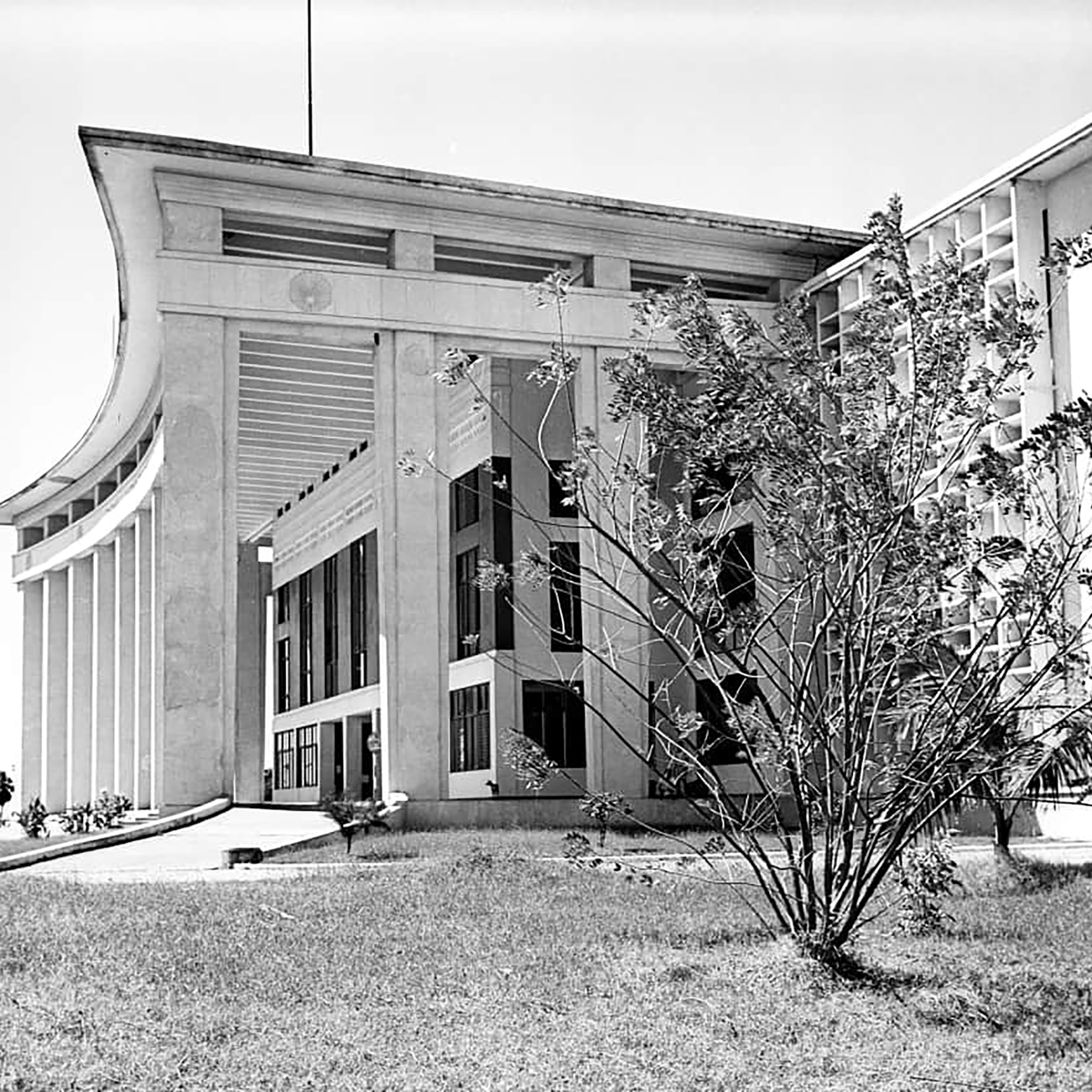
The RIT was the first institution in the entire country to offer architecture studies. It was built in 1958 by Soviet architect Pavel Steniushin with the intention of Myanmar’s government’s interest to build a new image for independent Myanmar and move away from colonial buildings. Later, the Military Regime changed the name to Yangon Technical University. However, more profoundly, this building tells the story of the initial steps to stage the protest of the U-Thant Funeral Crisis, in which the students from the RIT have taken the lead. Initially, the government planned to have the College of Engineering (Pyay Road) built. However, the Department for Architecture was moved here due to political decisions. This university building is considered a building of change on the political and architectural levels. It would represent a complex built in the post-modern era and show the adaptation of European modernism within the cultural context of Myanmar. On the urbanistic site, the objective was to develop the suburban area north of the Yangon University campus, capable of accommodating up to one thousand students. Soon enough, that area involved a vital district and would grow into the “most important centre for the preparation of specialists for many diverse branches of the national economy”, including architecture. The teachers were 90per cent Soviet lecturers. Until today, the tie between Russia and the Military Junta is alive with the downside for the people.
Civic Space Category educational
Built1058-1961
Please you can go to To-Gatherness and help us to create more content
Other Locations from this {post_terms_timeline:plain} Generation
Built in 1957, the Rangoon Engineering College (now Institute of Medicine-1) featured the iconic "Dome Hall," a civic space hosting cultural events until destroyed in the 1980s.

See other generations
First Generation
The 1947 Pinlon Agreement, championed by General Aung San, established a framework for Myanmar's multi-ethnic federal state, celebrated annually as "Union Day" on February 12th, but lat
Third Generation
The 1974 U Thant Crisis erupted when Ne Win refused proper burial for the former UN Secretary-General, sparking student protests that led to a memorial built in 1975.
Fourth Generation
The 8888 Uprising saw massive protests against General Ne Win's 26-year military rule in Myanmar, marking Aung San Suu Kyi's emergence as a democratic leader.
Fifth Generation
The 2007 Saffron Revolution saw Myanmar monks protesting rising prices, facing military blockades at key pagodas.
Sixth Generation
The 2021 Golden Spring revolution followed Myanmar's military coup against NLD's electoral win. Civil disobedience evolved into armed resistance as streets became protest spaces.