
Historic Rangoon Downtown Prison
An important building of the political struggle is the historic Rangoon Downtown Prison. In the case of Myanmar, it is essential to know that the Insein prison was the biggest prison to obtain obedience throughout the whole region of southeast Asia. Thirty-four prisons were all over the country by the time Myanmar received Independence. It highlights an important complex because usually, the prisoners have committed a “crime”, which was to liberate the people, a place of paradoxical usage. The Rangoon Downtown Prison and the Yangon Insein Prison were built by the British colony around the same year, 1866. The Insein Prison is in the very north near the city’s border and next to the airport. During the colonial period the biggest prison in all of Myanmar and even Southeast Asia. It was not only for the Burmese prisoners but also for the prisoners of the other countries of the colony. The Rangoon Downtown prison is just for the Burmese prisoners. Both prisoners are based on a hexagonal shape and are two stories high, and the Rangoon Downtown Prison is just a smaller-scale version of the Insein Prison. In both prisons were different cell types, death row, leprosy cells, solitary cells etc. During the Second WW II, the Downtown Prison was used for the prisoners of the war like the Japanese enemies, and it was used as such for five years. In 1945 during the Second WW II, it was used for prisoners of war from different countries. On the roof, one can see the rows for every country. Aung Saw Oo and Salai Kipp were imprisoned during the 1970s and ‘80s and were locked up in the historic Rangoon Downtown prison. They each were sentenced to prison for their involvement and activism during the student protest of the 70s and 80s.
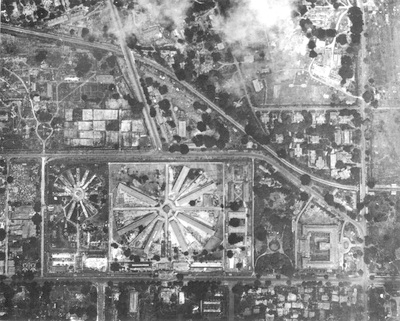
Civic Space Category administration /public service
Built1866
Demolished Time1985
Location AdressPyay Road / Bo Gyoke Road
Interviews
It is Our History
 When clicked, this video is loaded from Vimeo servers. See our privacy policy for details.
Other Locations from this {post_terms_timeline:plain} Generation
Founded in 1887, Yangon University became Myanmar's political epicenter. After losing autonomy in 1962, it faced shutdowns and restructuring due to student activism.
The U Thant Mausoleum, built near Shwedagon Pagoda in 1975, resulted from public protest against military disrespect for the respected UN statesman's funeral.
See other generations
First Generation
The 1947 Pinlon Agreement, championed by General Aung San, established a framework for Myanmar's multi-ethnic federal state, celebrated annually as "Union Day" on February 12th, but lat
Second Generation
Following the 1962 coup d'état, General Ne Win suppressed student activism by destroying RUSU and closing universities. This sparked underground resistance culminating in 1988 protests.
Fourth Generation
The 8888 Uprising saw massive protests against General Ne Win's 26-year military rule in Myanmar, marking Aung San Suu Kyi's emergence as a democratic leader.
Fifth Generation
The 2007 Saffron Revolution saw Myanmar monks protesting rising prices, facing military blockades at key pagodas.
Sixth Generation
The 2021 Golden Spring revolution followed Myanmar's military coup against NLD's electoral win. Civil disobedience evolved into armed resistance as streets became protest spaces.